
Operation carried out by No. 126 Squadron. The squadron's operational record links Cipriani's loss to the return from this operation.

01 / The man behind the aircraft
From Trinidad to the Royal Air Force
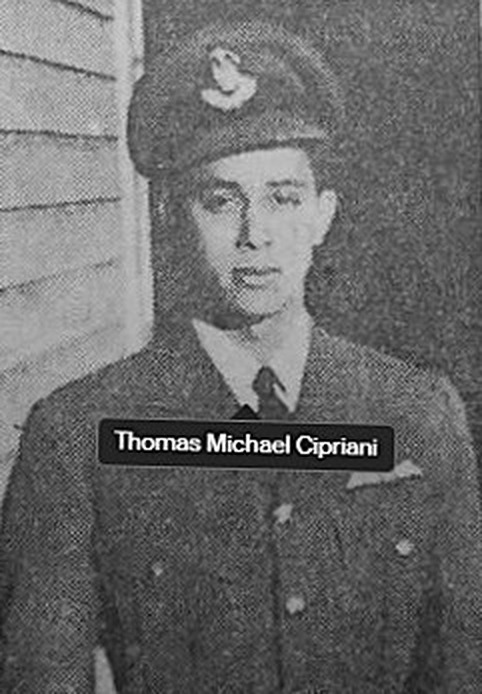
Thomas Michael Cipriani was only 22 when he died. He came from Port of Spain, Trinidad, and served as a fighter pilot in the Royal Air Force Volunteer Reserve during the Second World War.
He was the son of Michael and Daisy Cipriani, of Port of Spain. Historical accounts record that he attended Queen’s Royal College before leaving the Caribbean to serve in the RAF. His father, Michael “Mikey” Cipriani, had himself served during the First World War. Thomas thus belonged to a family whose history was marked by both world wars.
A published record of Caribbean RAF personnel lists his attestation on 19 February 1942 and his commission on 10 December 1943. His service number as an officer was 154714. He subsequently served with No. 126 Squadron RAF, flying the Supermarine Spitfire. These service milestones come from a later compiled record citing the RAF nominal roll, rather than being separately verified in an individual service file.
In 1944, the squadron was involved in operational flying over north-western Europe. Cipriani flew Spitfire LF Mk IX MH474, squadron code 5J-X as recorded in later aircraft histories.
The final flight: 21–22 November 1944
On 21 November 1944 Cipriani was returning from an operational flight. Accounts of the incident state that engine trouble forced him to land at the Allied airfield B.79 Woensdrecht, in the Netherlands. The aircraft was attended to there. On 22 November it took off again, but further difficulties followed.
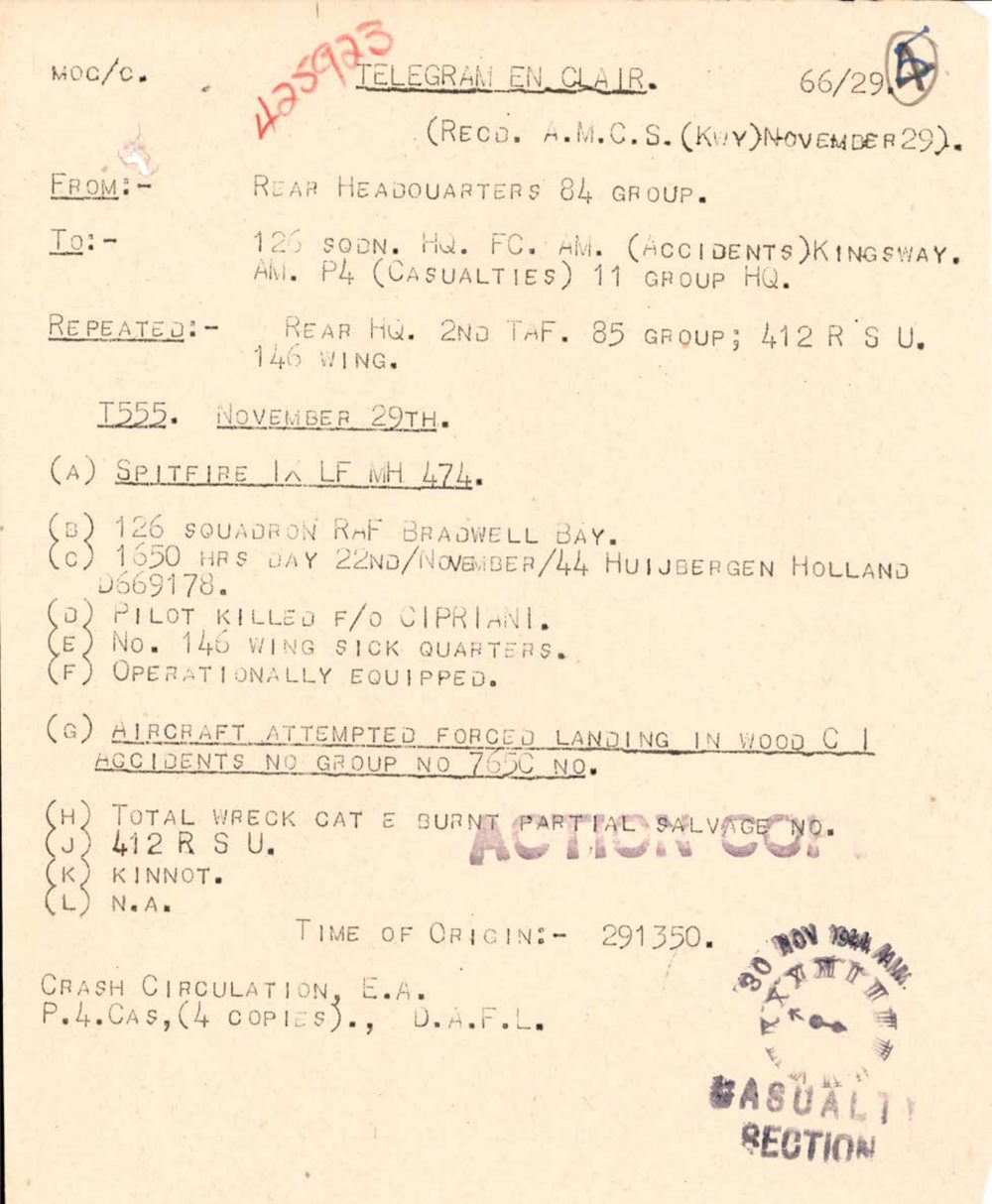
The RAF casualty correspondence directly identifies the aircraft, pilot and crash location: at approximately 16:50 on 22 November 1944, MH474 came down during an attempted forced landing in woodland near Huijbergen. The aircraft was destroyed by fire and Cipriani was killed. A later squadron report, dated 25 January 1945, independently names Huijbergen and gives map reference D.669178.
The exact mechanical defect is not conclusively established by the cited primary documents. Likewise, a story circulating in oral history that Cipriani deliberately struck an ammunition train is unconfirmed and is not presented here as a historical fact.
A son of Trinidad remembered in Antwerp
His death was reported in the Trinidad Guardian on 2 December 1944, alongside a photograph of the young pilot. He was buried on 27 November 1944 and now rests in Schoonselhof Cemetery, Antwerp, plot I, row A, grave 15. The Commonwealth War Graves Commission records his parents as Michael and Daisy Cipriani.
For decades the precise place of the crash was uncertain in published accounts. Research into Spitfire wreckage near Huijbergen later pointed towards this loss. Most decisively, the contemporary RAF casualty file now available identifies MH474, Cipriani and Huijbergen together. The aircraft is not simply a number in an archive: its story is also that of a young man who left Trinidad, became a fighter pilot and never returned home.
Biography sources: Trinidad Guardian (2 December 1944); Caribbean RAF personnel record; CWGC; RAF Casualty File P425923/44, pp. 29, 35 and 50. Municipality of Woensdrecht. Historical press photograph: publication rights of the 1944 Trinidad Guardian image should be verified before placing the site online.
02 / Chronology
What the records tell us
An RAF casualty telegram reports that MH474 crashed at Huijbergen during an attempted forced landing in woodland. The aircraft burnt and the pilot was killed.
Burial date recorded on the RAF burial documentation. Cipriani's grave is at Schoonselhof Cemetery, Antwerp.
Official RAF telegram documents the aircraft serial, pilot, date, time and crash location.
A No. 126 Squadron command report confirms Huijbergen and gives map reference D.669178.
03 / Primary evidence
Huijbergen: an established location
The official RAF casualty file, reference P425923/44, contains a telegram dated 29 November 1944 naming Spitfire MH474 and its pilot, as well as a crash near Huijbergen, Netherlands, at around 16:50 on 22 November 1944.
A squadron report dated 25 January 1945 independently supports the location. Consequently, the Huijbergen connection does not rest solely on later identification of wreckage.
The original RAF operational entry is less specific and should be read separately rather than treated as direct evidence of the crash location.
04 / Remembrance
Grave and commemoration
Flying Officer Cipriani is buried at Schoonselhof Cemetery, Antwerp, Plot I, Row A, Grave 15. The CWGC certificate and original grave registration are important sources. The RAF records show a burial date of 27 November 1944.
The personal dedication associated with his headstone reads:
“TO ONE WE'LL ALWAYS LOVE.
WE LOVED YOU THEN, WE'LL LOVE YOU EVER.
MONICA, HAROLD & MUM”
Original burial and grave documents
View the actual records rather than a summary. The RAF Burial Return records his burial on 27 November 1944. The original grave registration identifies Schoonselhof, Plot I, Row A, Grave 15.
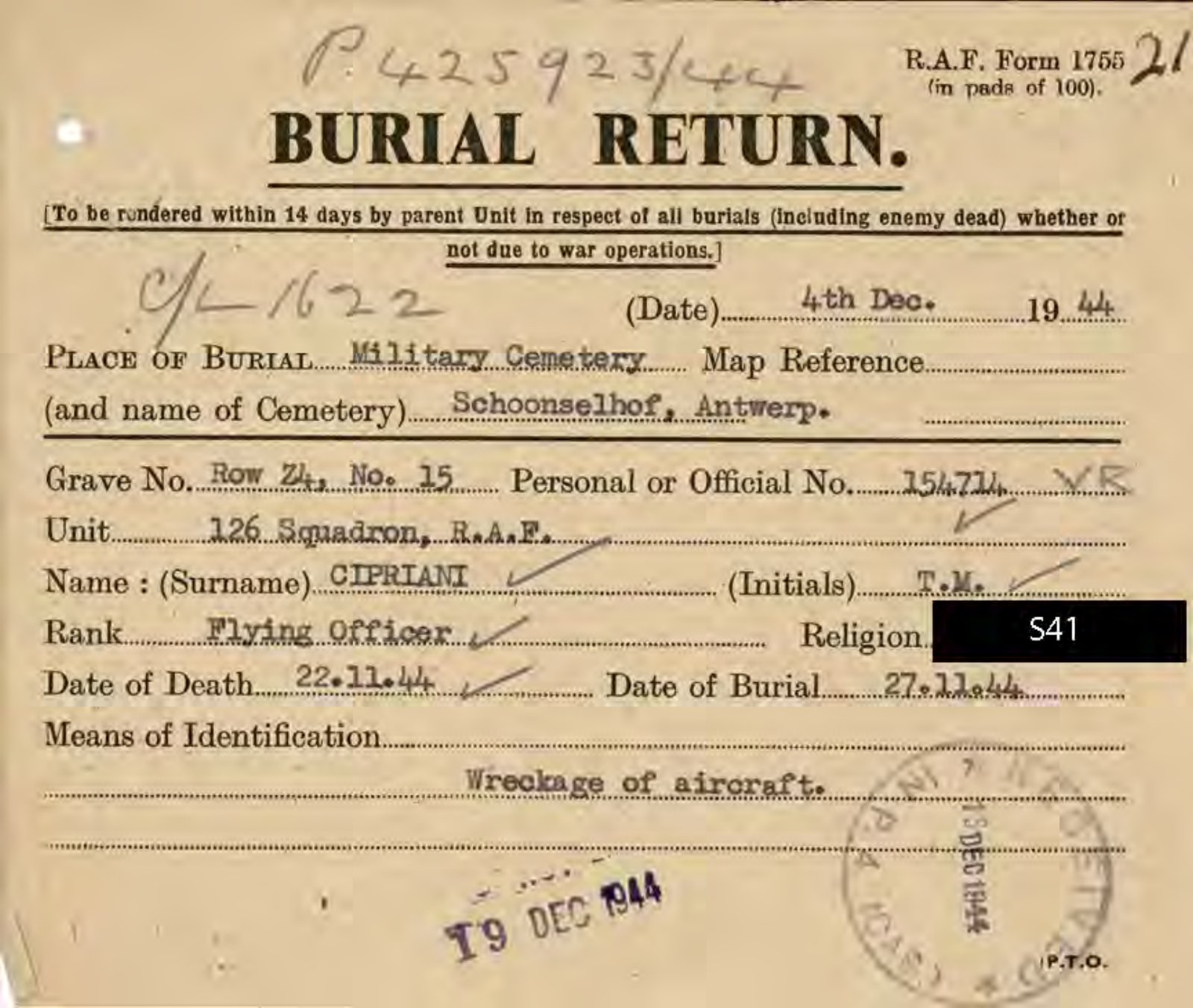
RAF Burial Return — 4 December 1944
Burial date: 27 November 1944. Original RAF form, Casualty File P425923/44, page 29.
Open original document (PDF)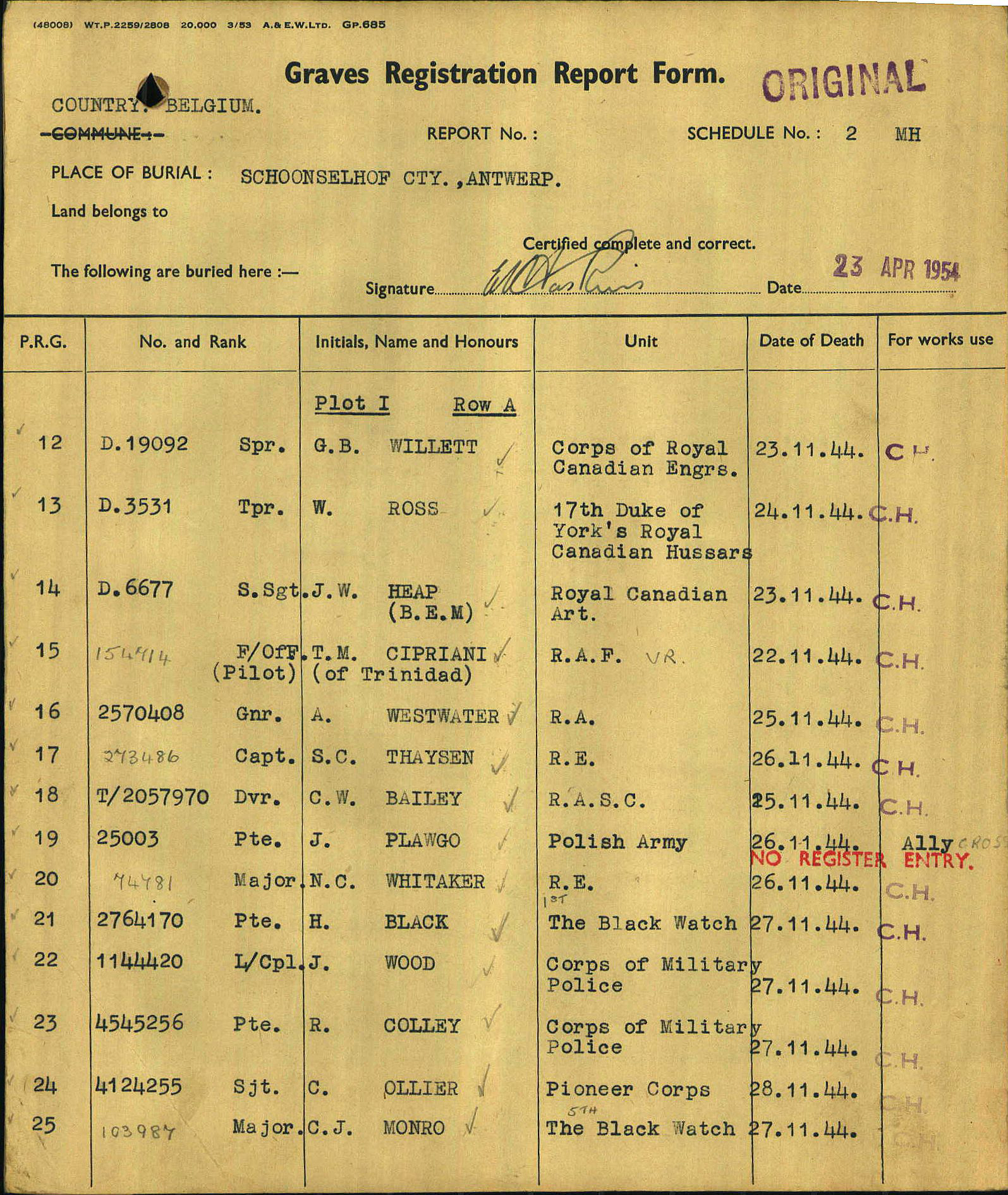
Graves Registration Report — 23 April 1954
Original grave registration: Schoonselhof Cemetery, Plot I, Row A, Grave 15.
Open original document (PDF)Sources: RAF Casualty File P425923/44, p. 29; Graves Registration Report, 23 April 1954; Commonwealth War Graves Commission. These are historical records, not a recent photograph of the headstone.
SOURCE GUIDE
What is the evidence?
Identity and biography
The Trinidad Guardian (2 December 1944), together with supporting biographical records, links the portrait to Cipriani.
Crash location and aircraft
RAF Casualty File P425923/44 names MH474, Cipriani and Huijbergen. See page 50 in particular.
Open the RAF casualty fileGrave and commemoration
CWGC records and the original RAF burial registration establish the burial location.
View the CWGC recordRAF burial return
Original grave registration
05 / Primary documents
Original records and research
Direct access to the selected evidence. The original items are kept intact and identified by their archival references.
RAF — No. 126 Squadron report (1945)
Original letter dated 25 January 1945 recording MH474 and Huijbergen.
View PDFGraves Registration Report — Schoonselhof
Official grave registration, grave I.A.15, certified 23 April 1954.
View PDFRAF — Burial Return (27 November 1944)
Single original RAF page: burial date and cemetery.
View PDFRAF Casualty File — P425923/44
54 pages · Official redacted casualty file; see p. 50 and January 1945 reports.
Read PDF (PDF) ↗RAF Operations Record Book — AIR 27/927/17
Operational entries for No. 126 Squadron, November 1944.
Read PDF (PDF) ↗RAF Operations Record Book — AIR 27/927/18
Further squadron operational documentation.
Read PDF (PDF) ↗CWGC — Thomas Michael Cipriani
Official commemoration certificate with burial details.
Read PDF (PDF) ↗RAF — FOI2026/23682
20 November 2026 response from RAF Air Historical Branch.
Read PDF (PDF) ↗Onderzoeksverslag / Research report
Updated 18-page dossier with original evidence, burial records and source notes.
Read PDF (PDF) ↗Publication note: these archival scans are included for research and source verification. Before republishing them on a public website, verify reproduction permissions and required credits with the relevant rights holders (including the UK Ministry of Defence, The National Archives and CWGC). A FOI disclosure does not automatically grant unrestricted reuse.